
Playoff Betting Strategy Across Major Sports
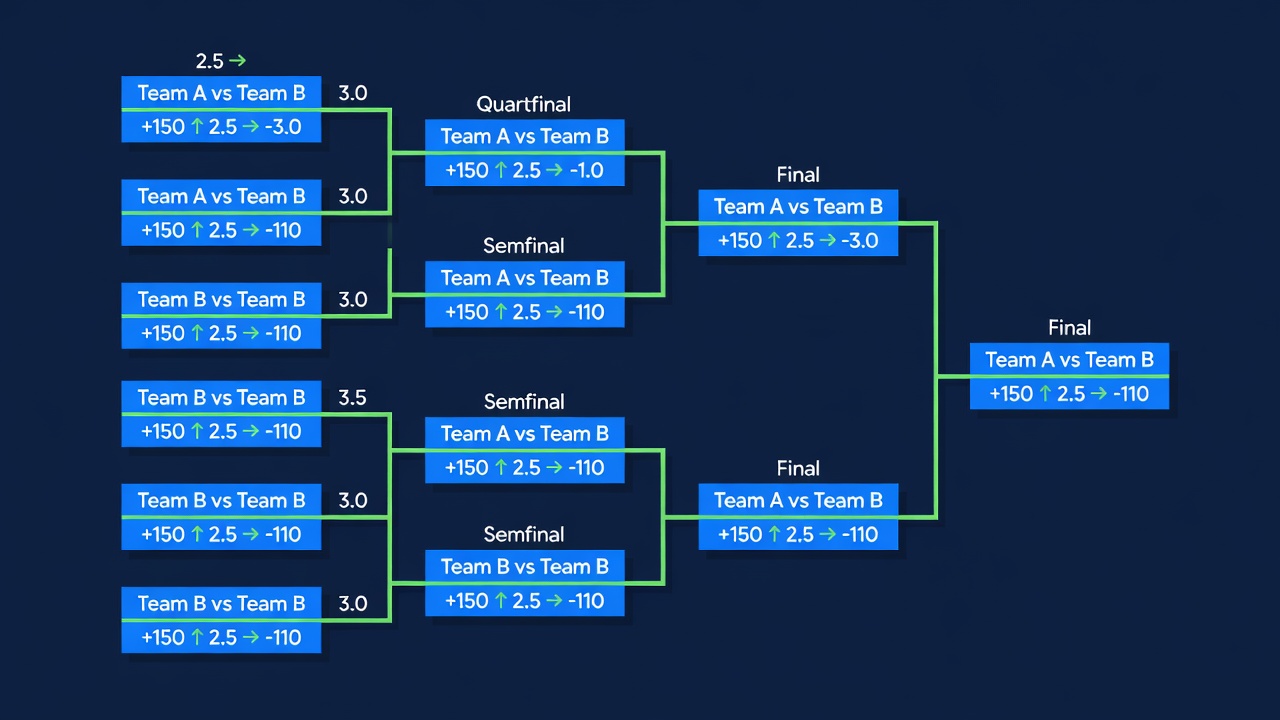
Playoff betting is not about predicting outcomes. It is about trading your belief in the future for present certainty. That is the only useful way to think about it if you want to stop losing money long-term.
Most bettors approach playoffs as a prediction problem: "I think Team A will beat Team B." This framing is deceptive. You are not predicting. You are trading your subjective probability estimate in the future for a third party's implicit probability (embedded in the sportsbook line). If your probability of Team A winning is 55% and the line's implied probability is 50%, you have an edge. But that edge exists only if your 55% assessment is actually correct.
The real question is not "Who will win?" but rather "How much is the bookmaker asking me for my uncertainty?" If Team A has a 55% true probability to win and the book offers minus-110 (implied 52.4%), the expected value of a 100-dollar bet is 2.20 dollars. Over a thousand bets, you gain 2,200 dollars. This is not free money. This is compensation for being right more often than you are wrong, with a betting amount that perfectly calibrates your true edge.
But playoff betting has a wrinkle: the opportunity cost of your capital is high. Playoffs are compressed into four weeks. If you tie up capital betting, you are sacrificing compounding returns elsewhere. An Austrian economist would ask: what is your discount rate? If you can earn 3% annually in a bond, that is 0.25% per month. A four-week return of 2.2% is 26.4% annually. If your outside opportunity cost is 0.25% monthly, the bet is profitable.
Most people have a zero percent opportunity cost (their money sits in checking). For them, a positive-expected-value bet that returns 2.2% per month is always rational. But they feel it as loss. If they lose a given month, they feel that loss acutely. They do not feel the opportunity cost of not betting, which is invisible.
The divisional-rivalry angle: the public bets more heavily on divisional rivalry games. This raises the variance of the lines. Bookmakers exploit this by sharpening lines on these games and softening them elsewhere. A disciplined playoff bettor will find better closing-line value on the third-string match nobody cares about. Your edge is highest where crowd attention is lowest.
The marginal bettor (you, presumably) should not bet on playoff games at all. Instead, identify which games the public is overweighting, then bet against the public on the underexposed games. This is not about playoffs. This is about where the inefficiency exists. Inefficiency is where returns concentrate.
Additional Context
Understanding this topic requires exploring multiple dimensions. The mechanics are one layer. The human behavior layer is another. The regulatory layer adds complexity. When these layers interact, they create the ecosystem that governs how Playoff Betting Strategy Across Major Sports actually works in practice.
Consider the historical precedents. How did operators approach this in the past? What changed? Why did it change? The answers reveal something important about the industry's priorities and constraints.
The current environment shapes what is possible. Regulatory requirements set boundaries. Player expectations set different boundaries. Technological capabilities enable new possibilities. Somewhere in the intersection of these three forces, the actual practice emerges.
The essential insight is that nothing in gambling is accidental. Every rule, every payout percentage, every interface design choice reflects deliberate decision-making by operators, regulators, or both.
The future will bring changes. Markets evolve. Technology improves. Regulations shift. What works now may need rethinking in five years. The best approach is to understand the underlying principles that drive decision-making, rather than memorizing surface-level facts that may become obsolete.
This exploration of Playoff Betting Strategy Across Major Sports is therefore not just informational. It is foundational knowledge that helps you understand the industry at a deeper level than the marketing and the noise.
Subjects in this guide
Pass it on
Choosing where to play? The casino ratings score each site on 6 checks, in half stars.
See the ratings