
Roulette House Edge: Every Bet Worked Out From the Pockets
Why American roulette bets all cost 5.26% except the 7.89% five-number bet, worked from the pockets, plus la partage, half-back and triple-zero wheels.
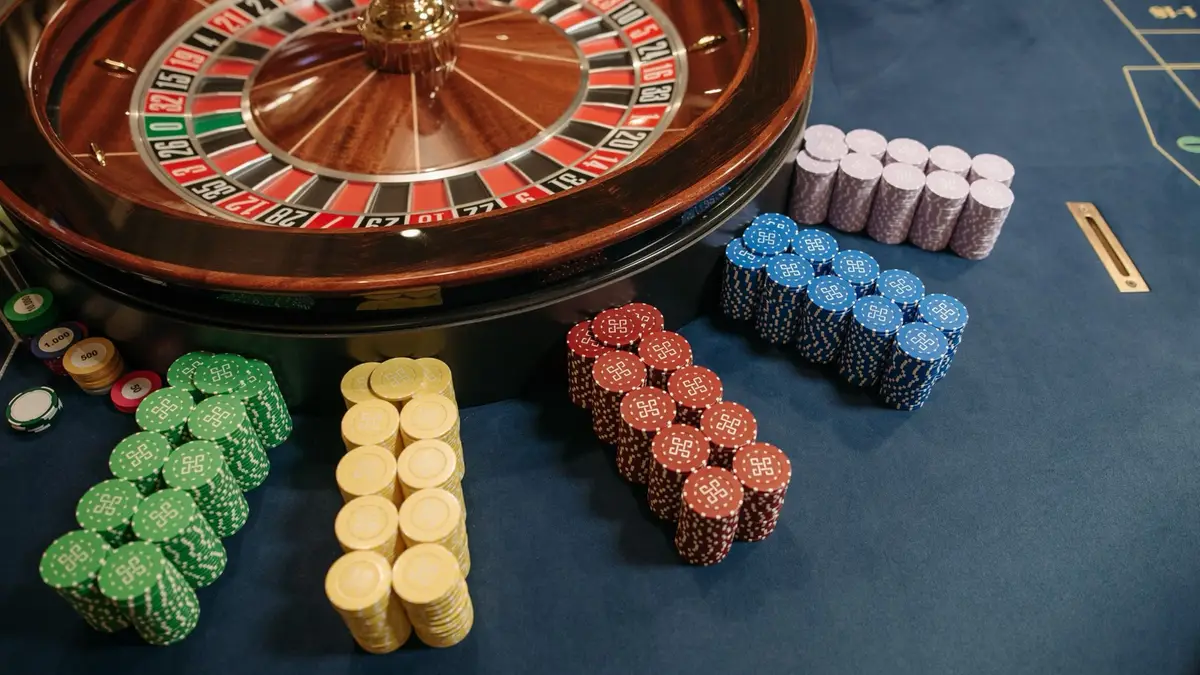
Photo: Pavel Danilyuk on Pexels
Jump to a section
- 01How do you work out the house edge from the pockets?
- 02Why does nearly every American roulette bet share one house edge?
- 03Why is the five-number bet the worst on the wheel?
- 04What does a single-zero wheel do to the house edge?
- 05How do la partage and the half-back rule cut the edge?
- 06What does a triple-zero wheel do to the house edge?
- 07Roulette house edge by wheel at a glance
- 08Guide questions
- Is roulette truly a fifty-fifty game?
- What's the safest bet in roulette?
- Is there a trick to winning roulette?
- Is roulette a skill or luck?
- 09Sources and further reading
The house edge in roulette comes straight from the wheel: the casino pays every bet as if the zero pockets did not exist. On an American double-zero wheel that leaves almost every bet at 5.26%, a single-zero wheel cuts it to 2.70%, and the one bet that breaks the pattern is the five-number bet on 0, 00, 1, 2 and 3 at 7.89%.
You do not have to take those figures on trust. Each one falls out of two numbers you can see at the table: how many pockets the wheel has, and what the bet pays. This guide works every figure through that way, then shows what the half-back rules and the newer triple-zero wheel do to it.
How do you work out the house edge from the pockets?
Imagine betting one unit on every possible result over one full turn of the wheel, each pocket coming up once. Add what the bet wins, subtract what it loses, and divide the shortfall by the number of pockets. That shortfall per unit staked is the house edge.
Take a straight-up bet on a double-zero wheel. The table has the numbers 1 to 36 plus 0 and 00, so 38 pockets, and New Jersey's regulation sets the straight-up payout at 35 to 1. Over 38 spins your number hits once and wins 35 units; the other 37 spins lose 1 unit each. You finish 2 units down on 38 staked, which is 2/38, or 1/19.
That 1/19 is exactly the figure the Wizard of Odds roulette payout chart gives for the American game: 5.26%. The method works for any bet, which is why the same idea underpins the site's house edge guide for blackjack, even though blackjack's sums are far messier.
Why does nearly every American roulette bet share one house edge?
Because the payouts are scaled to the count of numbers covered. Every standard bet pays as though the wheel had 36 pockets, so the two zeros always cost the same two units per 38 spins, whichever bet you choose.
The table below runs the same full-turn count for the common bets, using the payouts in the Massachusetts Gaming Commission roulette rules (as of November 2026).
| Bet | Numbers covered | Pays | Won over 38 spins | Lost over 38 spins | Net | House edge |
|---|---|---|---|---|---|---|
| Straight up | 1 | 35 to 1 | 35 | 37 | -2 | 5.26% |
| Split | 2 | 17 to 1 | 34 | 36 | -2 | 5.26% |
| Red, black, odd, even, high, low | 18 | 1 to 1 | 18 | 20 | -2 | 5.26% |
| First five (0, 00, 1, 2, 3) | 5 | 6 to 1 | 30 | 33 | -3 | 7.89% |
Notice that the net never changes for the bets that follow the pattern. Splitting your stake across more numbers spreads the wins out, but the casino's two pockets stay put. That is also why doubling systems on roulette cannot change the figure: every bet in the sequence carries the same 1/19.
Why is the five-number bet the worst on the wheel?
It is the only bet whose payout is not scaled to the numbers it covers. Both New Jersey and Massachusetts write it into their rules as its own wager. Massachusetts defines the first five numbers wager as covering 0, 00, 1, 2 and 3, and New Jersey sets its payout at 6 to 1. Over 38 spins it wins 5 times for 30 units and loses 33 times, a 3 unit shortfall. That is 7.89%, half as much again as every other bet on the same table.
What does a single-zero wheel do to the house edge?
It removes one of the two losing pockets, so the shortfall drops to 1 unit in 37. The single-zero house edge figure is 1/37, or 2.70%, on all bets.
The count is the same as before. A straight-up bet wins 35 units once and loses 1 unit on the other 36 spins, for a net of -1 on 37 staked. There is no five-number bet on this wheel, because there is no 00 to make up the fifth number, so the figure holds for every wager.
How do la partage and the half-back rule cut the edge?
They hand back half of an even-money stake when a zero lands, which halves what those bets lose to the zero pockets. They change nothing for inside bets.
Double-zero wheels in New Jersey. The state's rule lets the casino choose between taking either one-half or the entire wager on red, black, odd, even, low and high when 0 or 00 comes up, and the choice must be posted at the table. So a half-back rule can exist on an American wheel, by the casino's choice under the regulation. Massachusetts gives its licensees the same choice of half or all. Run the count: 18 wins, 18 losses on other numbers, and 2 zeros that each cost half a unit, so the net is -1 on 38. The Wizard of Odds puts the Atlantic City even-money edge at 2.63% with this rule.
Single-zero wheels with la partage. On a single-zero wheel, la partage returns half the bet when zero lands. The shortfall falls to half a unit in 37, which gives a 1.35% house edge on the two-sided outside bets only. In New Jersey, by contrast, even-money wagers on a single-zero wheel are lost when zero lands, so check the table before assuming the rule applies.
En prison. Instead of returning half, en prison holds the stake for another spin. Its value depends on the house rule for a second zero, and casinos treat a repeat zero differently: it may count as won, lost, la partage or another round in prison.
What does a triple-zero wheel do to the house edge?
It adds a third losing pocket while keeping the same payouts, so the shortfall grows to 3 units in 39. The triple-zero wheel's edge is 1/13, or 7.69%, on every bet.
Next to the double-zero figure of 5.26%, the third zero adds almost half as much again to what every bet costs.
Roulette house edge by wheel at a glance
The house edge roulette players face depends first on the wheel and then on the posted rule. Ranked from cheapest to dearest:
| Wheel and rule | Pockets | Shortfall per full turn | House edge |
|---|---|---|---|
| Single zero, la partage (even-money bets) | 37 | 0.5 | 1.35% |
| Double zero, half-back (even-money bets) | 38 | 1 | 2.63% |
| Single zero, standard | 37 | 1 | 2.70% |
| Double zero, standard | 38 | 2 | 5.26% |
| Triple zero | 39 | 3 | 7.69% |
| Double zero, five-number bet | 38 | 3 | 7.89% |
The ranking above is the practical takeaway. The wheel and the posted rule decide the cost of play far more than the bet you pick on it. To turn a percentage into an expected loss over many spins, the binomial distribution expected value guide works through roulette bets spin by spin, and the House Edge subject page gathers the same sums for other games.
Guide questions
Is roulette truly a fifty-fifty game?
No. An even-money bet on a double-zero wheel wins 18 times in 38 and loses 20, because both zeros beat it. On a single-zero wheel it wins 18 times in 37.
What's the safest bet in roulette?
On a single wheel, every standard bet carries the same edge, so no bet is cheaper than another except where a half-back rule applies to even-money bets. The five-number bet on 0, 00, 1, 2 and 3 is the one to avoid at 7.89%.
Is there a trick to winning roulette?
No bet or system removes the edge. Each spin pays as if the zero pockets were absent, so the shortfall applies to every bet, whatever the order or size of the stakes.
Is roulette a skill or luck?
The result of each spin is chance. The only choice that changes the long-run cost is which wheel and which posted rule you play under, from 1.35% with la partage to 7.69% on a triple-zero wheel.
Sources and further reading
- New Jersey Division of Gaming Enforcement (via Cornell LII): N.J. Admin. Code 13:69F-5.2 Roulette: payout odds, accessed 2026-11-23
- Massachusetts Gaming Commission: Roulette Rules (205 CMR), 2020-10-08
- Wizard of Odds: Roulette Rules, Payout Chart and House Edge, 2026-11-18
- Wikipedia: En prison, 2026-06-08
Topic of this guide
Pass it on

Choosing where to play? See the casinos we cover and our take on each.
Where to play