
Expected Value Definition, Worked Through Casino Bets
Expected value is a probability-weighted average. See why a roulette red bet wins 47.37% of spins yet still loses 5.26% of every unit staked.

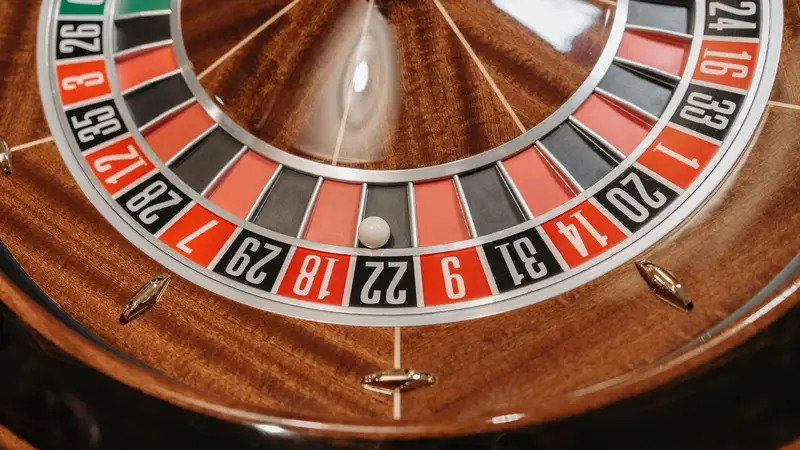
Photo: Pavel Danilyuk on Pexels
Jump to a section
- 01How do you define expected value?
- 02How to do expected value on a casino bet
- 03Why does a negative expected value bet still win often?
- 04How rule changes move expected value
- 05Is expected value the same as house edge?
- 06Guide questions
- What is the definition of the expected value in probability?
- How do I calculate the expected value?
- How do you calculate the expected value in AP Statistics?
- 07Sources and further reading
Expected value is the probability-weighted average of every outcome a bet can produce: multiply each result by its chance, then add the products. For a casino wager it tells you what you win or lose per bet on average across many repetitions, not what the next spin will do. That is why a bet can win often and still carry a negative expected value, and roulette's red bet shows it cleanly.
How do you define expected value?
For a bet with a fixed list of outcomes, expected value is the weighted average of those outcomes, with each outcome's probability as its weight. It is also the long-run average of independent repetitions, which is exactly what the law of large numbers formalizes.
That is the plain definition expected value rests on, and two consequences matter at a casino table. First, the expected value does not have to be a result you can get: a fair die has an expectation of 3.5, a face that never shows. Second, it describes the average over many trials, so it says little about any single bet. The idea itself came out of gambling: in 1654 the Chevalier de Méré put the problem of points to Blaise Pascal.
Once the definition is clear, the same weighted average extends to waiting times and streaks, which our guide to the expected value of a geometric random variable works through for casino waits.
How to do expected value on a casino bet
To work out the expected value of any wager, follow three steps:
- List every outcome with its net result in units (a win of 1, a loss of 1, and so on).
- Multiply each net result by the probability of that outcome.
- Add the products. A negative total is the average loss per unit staked.
Here is a 1-unit bet on red in American roulette, using the red bet's expected value calculation:
| Outcome | Probability | Net result | Contribution |
|---|---|---|---|
| Red wins | 18/38 | +1 | +18/38 |
| Red loses | 20/38 | −1 | −20/38 |
| Expected value | −2/38 = −5.26% |
The straight-up bet on a single number reaches the same place by a different route. A $1 single-number bet's expected value is −$1/19, so across 190 bets the net loss will probably be about $10. On a double-zero wheel the house edge is 1/19 on all bets except the 0-00-1-2-3 combination, which carries 7.89%. Different payouts, same expected value per unit.
Why does a negative expected value bet still win often?
Win frequency and expected value measure different things. On a double-zero wheel, red wins 47.37% of spins yet still carries a 5.26% edge, so a bet that wins nearly half the time loses money on average because the losing side is slightly more likely and the payout does not make up for it.
The gap appears because casinos pay below true odds. On a one-die wager, for instance, the casino may pay only 4 times the stake where fair odds would pay more. Every such shortfall becomes the house's expected profit.
Expected value also hides how wide a single session can swing. The expected loss grows in a straight line with the number of bets: after 10 spins at 1 unit the average house profit is 0.53 units. The spread of results, by contrast, grows with the square root of the number of bets, so over a short session luck dominates and over a long one the expected value takes over. The binomial distribution of roulette wins shows how many winning spins to expect over a set number of bets, and a bankroll management calculator turns that spread into stake sizes.
How rule changes move expected value
The same bet with the same win chance can carry a different expected value when the payout rules change. As of November 2026, Wizard of Odds lists these roulette edges (the expected loss per unit staked):
| Wheel or rule | House edge |
|---|---|
| Double zero, most bets | 5.26% |
| Double zero, 0-00-1-2-3 bet | 7.89% |
| Single zero, all bets | 2.70% |
| Atlantic City even-money bets | 2.63% |
With one zero the edge drops to 1/37, or 2.70%. In Atlantic City an even-money bet loses only half on 0 or 00, which lowers the edge to 2.63%. The win chance on red has not moved at all; only the amount returned on a loss has, and that alone roughly halves the expected loss.
Is expected value the same as house edge?
House edge is expected value turned around and stated against the original bet, so for simple even-money wagers the two match. Caribbean stud poker's 5.22% house edge sits close to double-zero roulette at 5.26%, but the average loss against money actually wagered in Caribbean stud is only 2.56%. Comparing games on edge alone can mislead, a point our house edge guides return to game by game.
Guide questions
What is the definition of the expected value in probability?
For a random variable with a finite list of outcomes, the expected value is the average of those outcomes weighted by their probabilities. Read over many independent repetitions, it is the long-run average result.
How do I calculate the expected value?
List every outcome with its net result, multiply each result by its probability and add the products. For a 1-unit red bet in American roulette that gives (18/38 × 1) + (20/38 × −1) = −2/38, or −5.26% per unit staked.
How do you calculate the expected value in AP Statistics?
The method is the same weighted average: write the values the variable can take, pair each with its probability, multiply and sum. A fair die worked this way gives 3.5, which shows that the expected value need not be a result you can actually roll.
Sources and further reading
- Wikipedia, Expected value, accessed November 2026
- Wizard of Odds, Roulette Rules, Payout Chart and House Edge, November 2026
- Wikipedia, Casino game, accessed November 2026
- Wizard of Odds, Casino House Edge Chart by Game, accessed November 2026
Topic of this guide
Pass it on



Choosing where to play? See the casinos we cover and our take on each.
Where to play