
Bill Kaplan and the MIT Blackjack Team: The Untold Story
A high-energy breakdown of how Bill Kaplan helped create the most famous card-counting operation in history, proving that math beats casinos.
Jump to a section
Okay, so everyone knows the MIT Blackjack Team story, right? But here's the actually insane part that nobody talks about: the whole thing started with a guy named Bill Kaplan, and this is genuinely wild.
The Setup
So Bill Kaplan graduates from MIT (obviously) and he's good at math. Like, really good. We're talking about someone who understands probability at a level that most humans don't. But here's the thing: he's not a gambler. He wasn't some guy dreaming about beating the house since he was five years old. He was just a math guy.
And then he gets approached by some other MIT kids who are actually playing blackjack with a counting system. And Bill Kaplan looks at their system and he's like, "No, wait, you're doing this wrong." That's actually how the MIT Blackjack Team gets formed, which is insane. Not by some visionary who builds it from scratch, but by a math nerd who sees bad math and can't help himself from fixing it.
The year is 1979. Card counting is known but nobody's really systematized it. Kaplan looks at what's happening and realizes you can actually optimize this. You can make it faster. You can make it better. You can turn it into actual, provable profit.
Here's what makes this the crazy part: he creates this entire apparatus. The team structure. The bankroll management. The signaling between counters and big-money players. This isn't lucky gamblers. This is like... a startup, but for beating blackjack.
The Numbers
Let's talk about what actually happened:
- The team recruited MIT students specifically for mathematical talent, not gambling experience
- They operated from 1979 through the early 1990s, running multiple teams across different casinos
- Their profits were legitimately massive, estimated in the millions of dollars across the entire operation
- The approach was scientific: they tested strategies, measured results, optimized constantly
The thing nobody expected was how disciplined they were. These weren't cowboys. They had accounting. They had expected-value calculations. They had stop-loss procedures. You lose more than X dollars, you stop playing. That's it. You do not chase. You do not gamble emotionally. You execute the system.
How They Actually Won
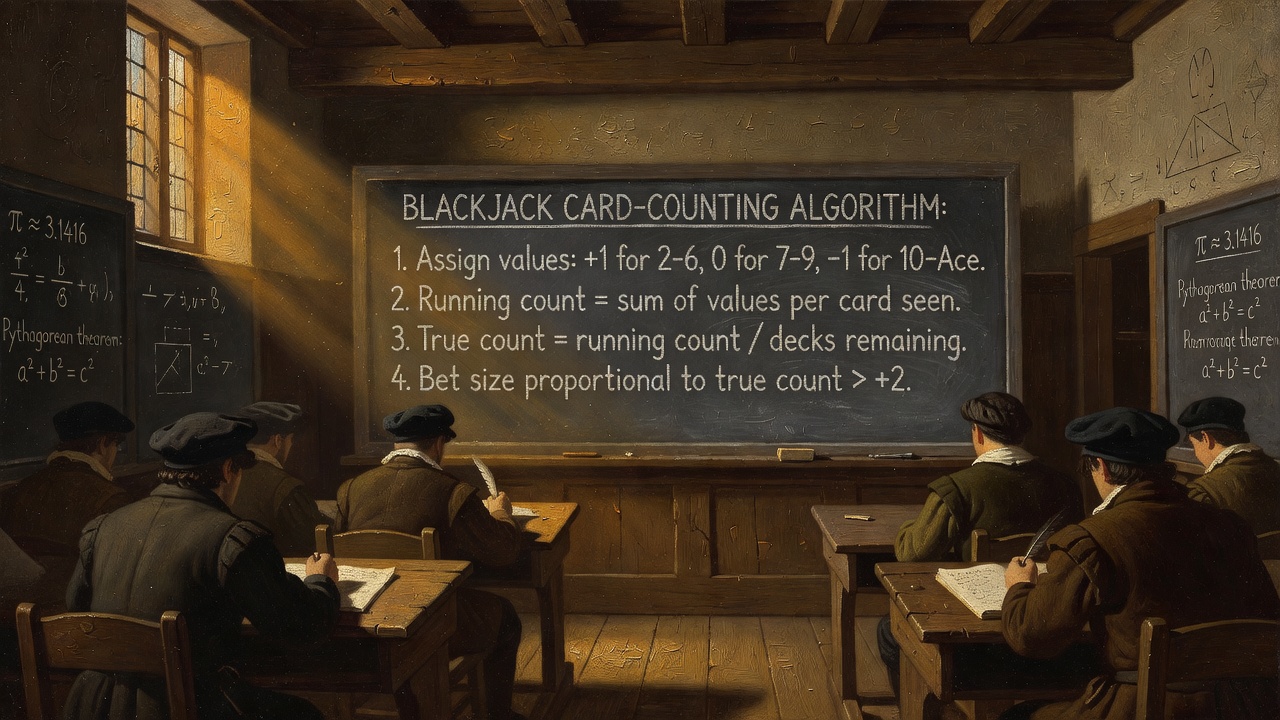
Okay, so basic blackjack advantage play. When the deck is rich in tens and aces (high cards), the player's advantage increases. When it's rich in low cards, the house edge increases. Kaplan's team didn't just count. They counted and they bet according to the count.
High count? Bet more. Low count? Bet the minimum or step away. A normal player might be off by a fraction of a percent in terms of edge. Kaplan's team was consistently playing with a two to three percent advantage. That's absolutely nuts. That's not luck. That's mathematical dominance.
But here's what gets really interesting: they had one person doing the counting (the counter) feeding information to another person doing the betting (the big-money player). The counter would sit at the table and use subtle signals. A scratch. A shuffle of chips. A specific comment about the weather. The big player would catch these signals and then place massive bets when the count was favorable.
Casinos couldn't prove it was card counting because it's not technically illegal. What casinos did was ban players they suspected of counting. And once they figured out Kaplan's team was operating, things got ugly.
The Downfall
Eventuallly casinos got serious. Facial recognition technology started showing up (this is the late 1980s, early 1990s). Dealers got better at shuffling. Rules changed. The rich-deck play got weaker.
But that's almost not the point. The point is that Kaplan proved something actually fundamental: if you have better information and better discipline than everyone else at the table, you will win. The math wins. Mathematics just wins. It's not a miracle. It's not luck. It's what happens when someone with real education plays against people making intuitive decisions.
The MIT Blackjack Team produced multiple documentaries, books, and even a movie ("21") because what they did was captivating. But Kaplan's contribution specifically was showing that you could industrialize advantage play. You could build an organization around it. You could treat casino profit like a business problem to be solved.
And for a while, they actually solved it. They beat the house so badly that the house had to change the rules of the game just to make sure it didn't happen again. That's powerful.
Subjects in this guide
Pass it on
Choosing where to play? The casino ratings score each site on 6 checks, in half stars.
See the ratings