
Ken Uston: The Blackjack Hall of Famer Who Sued Casinos
Ken Uston was not a card counter. He was a systems designer. And when casinos tried to ban him, he sued. This is the story of the man who proved casinos could not legally exclude skilled players.
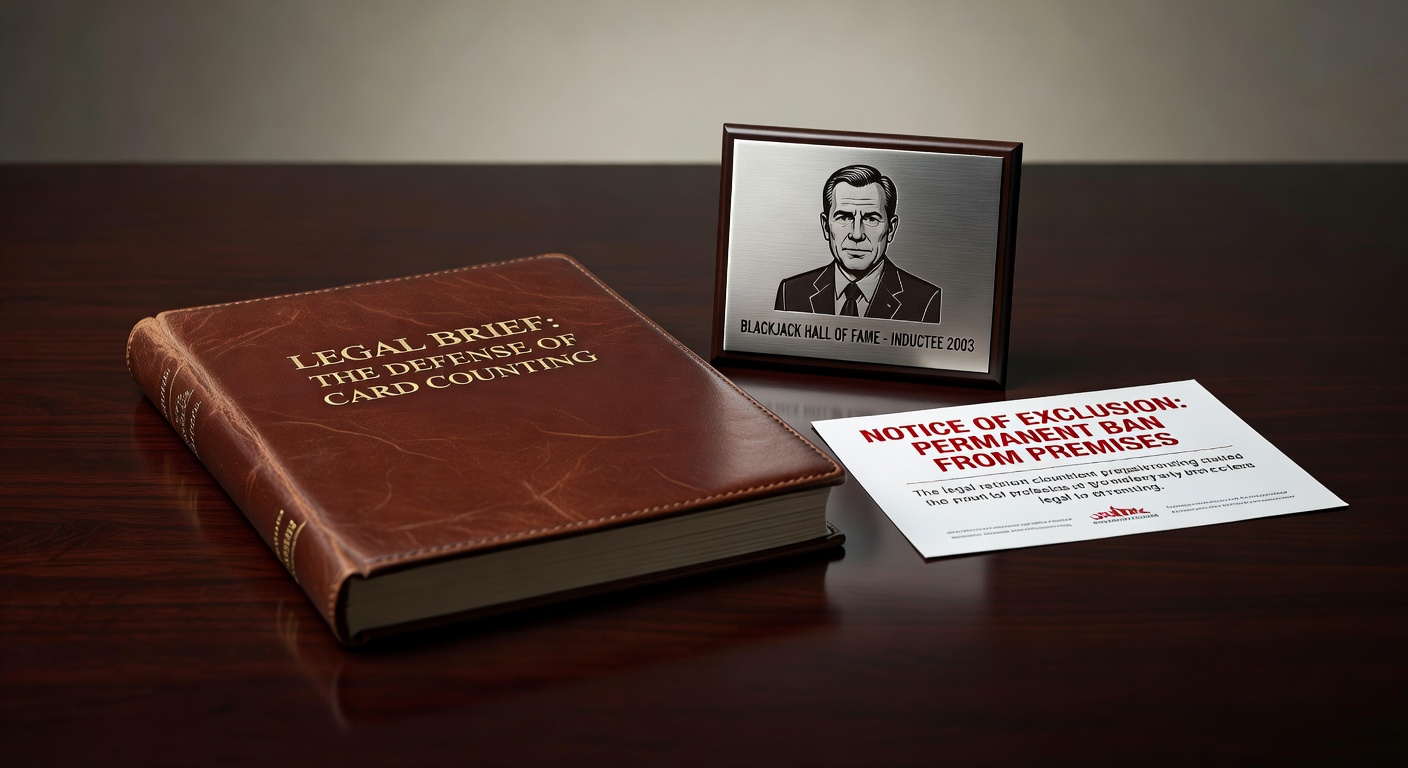
Ken Uston's real innovation was not a blackjack strategy. It was understanding that casinos operated under legal constraints most players did not know about.
In the 1970s, a man who could read a deck like a musician reads sheet music could make money at blackjack. The game was full of opportunity. Soft 17s, liberal doubling rules, 3:2 payouts. A card counter working a 1-2 bet spread could expect a 1-1.5 percent edge over thousands of hours.
Ken Uston could do more. He could teach others.
The System
Uston did not invent card counting. The MIT Blackjack Team did that, in a sense (though others before them had the idea). But Uston designed the systems: the drills, the organizational structures, the crew management. You could take twenty-five people with no prior casino experience, run them through Uston's program, and have five of them ready to play blackjack at a competitive level within six weeks.
This is game design. Not the game itself, but the meta-game of learning to play it.
Uston ran multiple crews simultaneously. Spotters. Counters. Big-money players. Surveillance roles. He managed information flow. He designed incentive structures: how much does a spotter earn relative to a counter relative to a big player. He built redundancy: multiple crews meant the house could ban one team and Uston still had four others in the field.
The house edge was math. The meta-game was execution.
The Legal Angle
Casinos banned Uston. They put his face in the Griffin Book, the shared database of known advantage players. He could not walk into a major casino without being escorted out.
So he sued. In 1979, Uston filed suit against the Sands Casino in Las Vegas, claiming that casinos could not legally exclude skilled players from public accommodations.
The case hinged on one point: are casinos private clubs or public places? If public, they cannot discriminate against paying customers based on skill. If private, they can ban anyone.
Nevada courts ruled against Uston. Casinos, the reasoning went, have the right to set their own house rules, including whom they will serve.
But Atlantic City was different.
Atlantic City Breakthrough
Uston moved his lawsuit from Nevada to New Jersey. Atlantic City casinos had just opened. The state had a different legal framework: strict consumer protection laws, public accommodations laws. When Uston sued in Atlantic City in 1982, the New Jersey Supreme Court sided with him.
The landmark ruling: casinos cannot ban skilled players based on past play. They can ban card counters if they catch them in the act (because card counting, technically, is a form of cheating under New Jersey law). But they cannot use historical records or shared databases to bar players preemptively.
Uston had just won a legal game-design argument. He had changed the rules that casinos could play by.
The Fall
He did not enjoy the victory long. Casinos adapted. Within two years, they had implemented:
- Six-deck shoes instead of single deck games
- Frequent shuffles that cut the penetration
- Continuous shuffle machines
- Dealer training in how to spot counters
Uston's edge disappeared. The game design that had allowed him to profit dried up. The legal victory meant nothing if he could not actually play the game.
He moved on to video poker, where he found another edge: machines that had not yet been fully optimized by their manufacturers. He consulted, advised, played.
In 1987, at fifty-two, Ken Uston died of a heart attack in Paris. The blackjack wars had moved on. The game had evolved around him.
The Legacy
Uston is famous for being a card counter. That is the reductive version. The actual story is more interesting: he understood that games are systems, that systems have rules, and that the rules themselves are sometimes exploitable.
He could have just counted cards. Instead, he designed a business. When that business faced legal constraints, he fought the constraints. When casinos adapted the game design, he moved to a different game.
That is the game designer's move: see the system, exploit the system, adapt when the system changes, and move on.
Subjects in this guide
Pass it on
Choosing where to play? The casino ratings score each site on 6 checks, in half stars.
See the ratings