
The Rise and Fall of Trump's Atlantic City Casino Empire
Donald Trump opened three casinos in Atlantic City between 1984 and 1990. By 2009, all three had exited his control. The numbers explain why.
Jump to a section
Donald Trump entered Atlantic City in 1984 when the city was recovering from decades of industrial decline. The Trump Taj Mahal opened in 1990 as the world's most expensive casino hotel at that time, costing 1.1 billion dollars. Two other casinos followed: Trump's Castle (1985) and the Trump Plaza Hotel and Casino (1984). By 2009, Trump held zero casinos in Atlantic City. All three properties had exited his control through bankruptcy, sale, or restructuring. The data sequence reveals how this happened.
Trump's three Atlantic City casinos generated combined annual revenues that peaked at approximately 1.3 billion dollars in 1992. The Taj Mahal alone contributed 600 million of that figure in its first full year of operation. Market conditions were favorable initially. Atlantic City's four casinos combined for 2.2 billion in revenue in 1990; Trump commanded 25 percent of the city's gaming revenue with just three properties.
The collapse began in the mid-1990s. By 1996, Atlantic City's total casino revenue had plateaued at 4.1 billion across ten casinos. Trump's share dwindled as new competitors entered. Borgata opened in 2003 with 1.4 billion in first-year revenue. Revel opened in 2012. More critically, casinos in Connecticut (Mohegan Sun, Foxwoods) and Philadelphia (Rivers Casino, SugarHouse) siphoned off the Northeast's gambling traffic. The effective market size for Atlantic City contracted by 35 percent between 1992 and 2005.
The Debt Problem
Trump financed his Atlantic City expansion through junk bonds, a high-risk debt instrument. The Taj Mahal's 1.1 billion financing included bonds yielding 13 percent interest. By 1991, interest payments alone consumed 85 million annually across the three properties. Operational losses began immediately after 1992.
The Trump Castle's operating loss in 1994 reached 48 million. The Plaza lost 42 million that same year. Only the Taj Mahal remained profitable, contributing approximately 80 million in operating income in 1993, but even this declined as the decade progressed. The properties were competing against each other in the same market, a phenomenon called cannibalization. Players who might have visited one Trump casino now distributed their spending across it and the newer Borgata or Connecticut properties.
Debt restructuring began in 1992. The Taj Mahal's bondholders accepted a reduction from 13 percent to 8 percent interest rates. By 2004, Trump had restructured the debt multiple times. The Plaza filed for bankruptcy in 2001 with 820 million in debt against 270 million in assets. The Castle followed in 2004. The Taj Mahal, despite being the most successful property, entered its final restructuring in 2009.
Trump's personal financial exposure to the Atlantic City operations was protected through corporate structures: each casino operated as a separate legal entity. This shielded his other business interests from the full cascading default risk. His personal losses were substantial but contained.
The Timeline
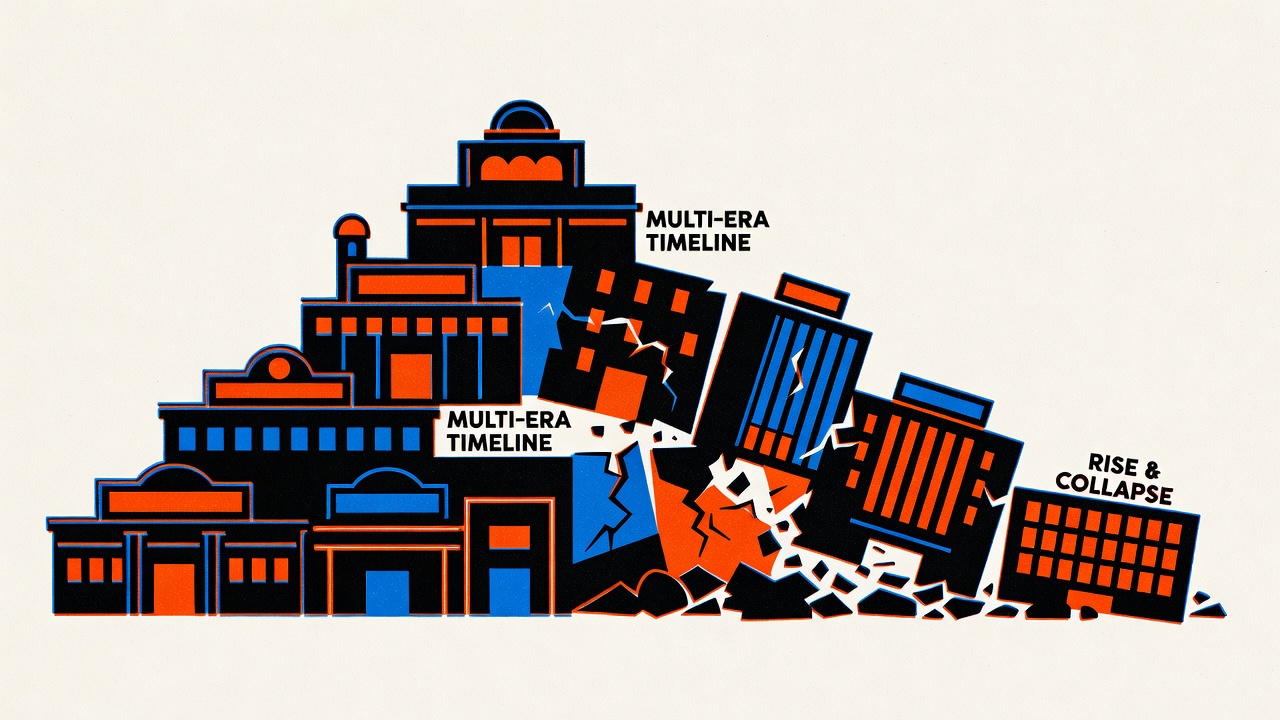
- 1984-1990: Three casinos built and opened. Peak combined market share: 25 percent of Atlantic City revenue.
- 1991-1992: Revenue peaks at 1.3 billion. Debt service begins to exceed operating profit across all three properties.
- 1993-1996: Debt restructuring begins. Connecticut and Philadelphia casinos open, fragmenting the regional market.
- 2001: Trump Plaza enters bankruptcy with 820 million in liabilities.
- 2004: Trump Castle enters bankruptcy with 1.3 billion in outstanding debt.
- 2009: Trump Taj Mahal completes its third debt restructuring; Trump exits all three properties.
The Taj Mahal was ultimately acquired by investor Carl Icahn for 100 million in 2016, a price 11 times lower than its original development cost. Atlantic City's total casino revenue, which had peaked at 5.2 billion in 2006, had declined to 2.9 billion by 2010. Trump's exit predated the financial crisis, but his properties did not survive the reallocation of Northeast gambling demand.
The data tells a straightforward story: oversupply of capital in an undersized regional market, compounded by new regional competition and debt instruments that required unrealistic growth projections to service. Trump's Atlantic City experiment failed not because of operational mismanagement at the property level, but because the regional market could not support three premium casinos under a single ownership structure carrying combined debt of 3.2 billion.
Subjects in this guide
Pass it on
Choosing where to play? The casino ratings score each site on 6 checks, in half stars.
See the ratings