
The Accumulator King: Steve Whiteley's 1.45M Pound Payout
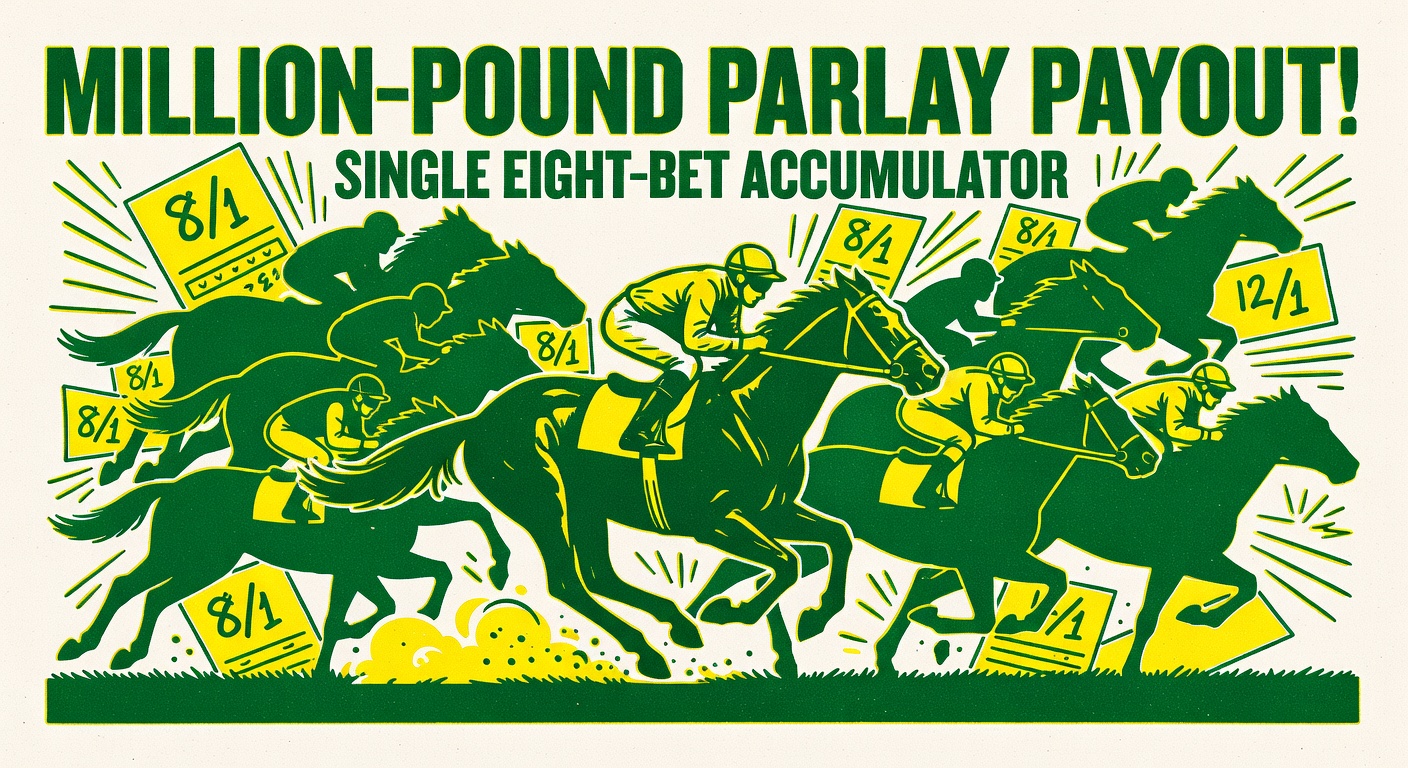
Steve Whiteley placed an accumulator bet (a parlay) on horse racing. He won roughly 1.45 million pounds on a small stake. This is what happens when eight straight bets come in.
Jump to a section
An accumulator is a parlay. You pick multiple events. Each one has to come through, or the whole bet loses. But if they all come through, your payout is multiplied by each leg.
Steve Whiteley picked eight horse races. Each one had to come through. The odds on each race were not terrible, but they were not obvious. He was betting on live events with real uncertainty.
When all eight came through, his initial bet of maybe 50 pounds turned into 1.45 million pounds.
The Mathematics
Let's say each race had 5-to-1 odds. An accumulator of eight legs at 5-to-1 each is:
5 x 5 x 5 x 5 x 5 x 5 x 5 x 5 = 390,625 to 1 odds.
If you bet 10 pounds, you win 3.9 million pounds (roughly).
Whiteley's actual odds were probably lower per leg (maybe 2-3 to 1 on average, meaning horses he had good reason to think were likely to win), which is why his payout was lower.
But still, an accumulator of eight winners at 2-to-1 per leg is 256 to 1 odds. A 50-pound bet at 256-to-1 is 12,800 pounds. If the odds were more generous, it scales up.
The Selection
For an accumulator to be profitable long-term, you have to be better at predicting horse races than the market. The market (other bettors, the sportsbook) sets the odds. If you think the odds overvalue the horse (offer worse odds than the horse's true probability), you have an edge.
Pickingone race correctly is hard. Picking eight in a row is extremely unlikely unless you have a genuine edge.
Whiteley's result suggests either: he had a very good prediction on eight races, or he got lucky. Probably both.
The Coverage
Whiteley's win became famous because it was rare and because it happened at a major British sportsbook. Newspapers covered it. Betting shops talked about it.
For the sportsbooks, rare large payouts are marketing gold. They show their customers: you can win large amounts. It keeps the recreational players coming back, hoping for their own lucky run.
The Odds
The probability of hitting eight legs at (average) 50 percent accuracy per leg is:
0.5^8 = 0.39 percent. (Less than half a percent.)
If millions of people place accumulator bets, some percentage of them will hit eight or nine legs. The math guarantees it.
But any individual person is almost certain not to.
The Narrative
Whiteley's bet is the accumulator king story. It supports the fantasy that a small bet can turn into life-changing money.
It is true. It can happen. The odds are just very, very bad that it will happen to you.
For the sportsbooks, Whiteley's payout is a valuable advertisement. It costs them 1.45 million pounds to show millions of players that 1.45 million pound payouts are possible.
That is a good investment for a major sportsbook. They will take that deal every time.
Additional Perspective
The underlying principle here is straightforward: understanding how the mechanics work gives you an edge in decision-making. Whether you are playing for fun or trying to optimize your approach, the details matter. The math is real. The odds are fixed. But your awareness of these facts changes how you engage with the game. Take time to learn the specifics before you commit significant money. Read the terms. Understand the edge. Make informed decisions. That is how you play with eyes open, not hoping for luck but understanding probability.
Subjects in this guide
Pass it on
Choosing where to play? The casino ratings score each site on 6 checks, in half stars.
See the ratings