
What Is a Poker Rakeback?
You play poker, the house takes a cut, but what if that cut comes back to you? Rakeback is the best-kept secret in poker rooms.
The Setup
Picture this. You walk into a poker room. The action is flowing. Money is moving across the table. Cards are flying. The energy hits different because the rake is about to hit you.
Rake is the house's tax on poker. Usually 5 percent of the pot up to a cap. You win 500? The house gets 25. You win 2000? The house gets their cap, usually 5 or 10 dollars. It adds up. Over a year, tight players watching their bankroll are bleeding money to rake that they never actually see getting handed over.
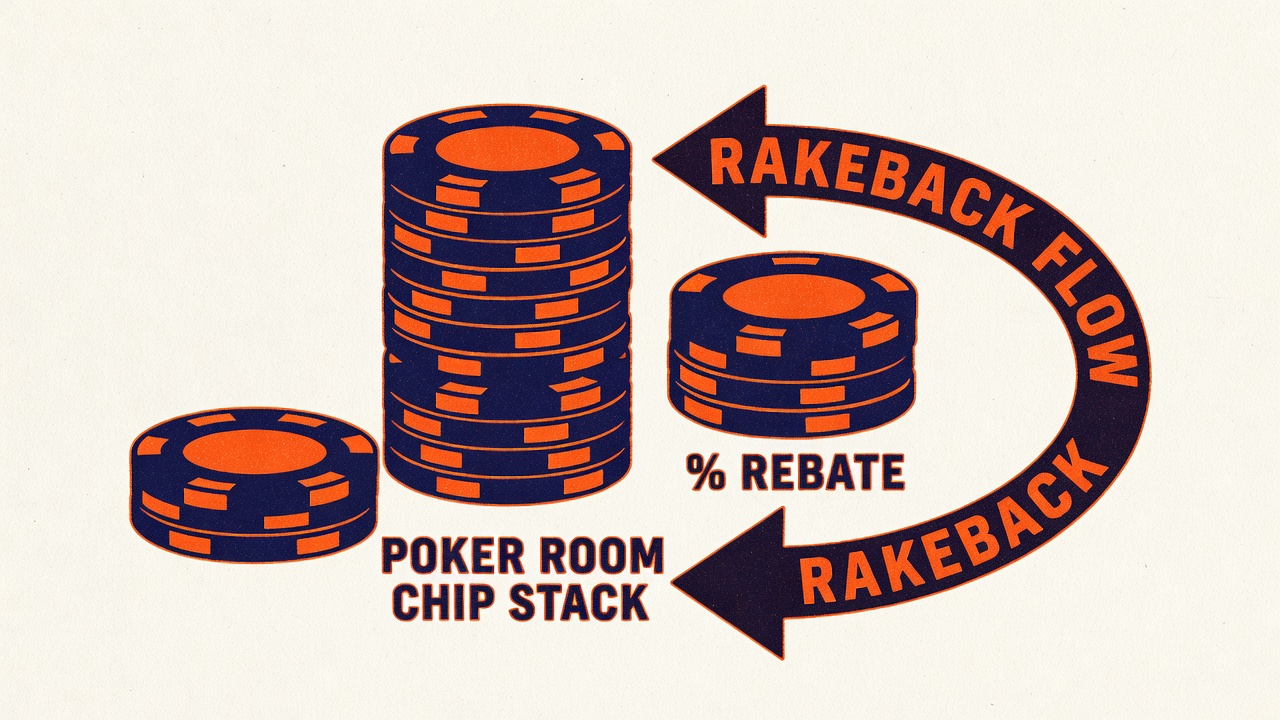
Rakeback inverts this equation. Instead of the rake disappearing into the poker room's vault, a percentage of that rake comes back to you. At some rooms, the structure is straightforward: earn rakeback at 27 percent. You generated 10,000 dollars in rake for the house over a month. You get 2,700 dollars back. That is real money. That is bankroll recovery. That is the difference between breaking even and booking a solid win when the cards were running against you.
Why do rooms offer this? Because poker is not about individual hands anymore. Poker is about bringing players into the ecosystem and keeping them there. A player who rakes 500 dollars monthly is a player worth 135 dollars in rakeback. That player is also a player who runs deeper, plays longer sessions, stays loyal to the room. The rakeback is not a loss for the operator. It is an investment in retention that costs less than advertising would cost to acquire the same player.
The mechanics get deeper. Many rooms tier rakeback. You start at bronze, 15 percent. You grind to silver, 25 percent. You hit gold and you are getting 35 percent. Each tier shift changes your economics. A 2000 dollar monthly rake generator at bronze makes 300 dollars. At gold, that same player makes 700 dollars. That difference is motivational. Players start optimizing their game not just for win rate but for rake generation. More volume. Longer sessions. More time at the table.
Online poker rooms weaponized this. DraftKings, Bet365, these rooms offer rakeback tied to loyalty programs. You earn tier points as you rake. Those points convert to cash or bonus. The acceleration is real. A grinder playing 40 hours weekly at online stakes will generate enough rakeback to cover variance in lower-end downswings. Rakeback becomes a form of insurance. Not against losing. Against losing badly.
The best rooms know this. They structure rakeback as the primary profit center for serious players. Your hourly rate plus rakeback equals your expected value. This is why the best players gravitate toward rooms with the highest rakeback. PokerStars versus Bet365 versus smaller regional sites. The operator with rakeback rates matching the players' expectations will hold the volume.
What makes rakeback insane is that it is free money from your perspective. You were going to play anyway. The rake was going to get taken anyway. Rakeback is the room saying: we want you here badly enough that we will share our take. The players who treat rakeback as a bonus are missing the point. The players who factor rakeback into their hourly rate and then move to the highest rakeback room are the ones grinding out real profits.
This is why newer players should ask about rakeback in their first conversation with a poker room. The difference between 15 percent and 35 percent over a year is not marginal. For a solid midstakes player, that is thousands of dollars that should be in your pocket, not the house's pocket.
Pass it on
Choosing where to play? The casino ratings score each site on 6 checks, in half stars.
See the ratings