
Multi-Tabling Online Poker: How Many Tables Is Too Many
Jump to a section
Frank Lloyd Wright designed the Luxor in Las Vegas as a pyramid. Odd choice. Most casinos are rectilinear because sightlines matter. You want to see the slots from the craps pit. You want the baccarat players to hear the roulette wheel. The architecture is a machine for extending play time. The Luxor breaks that rule because its designer was Wright, not a hotel manager.
Online poker rooms don't have architecture. They have interface. But the principle is the same: you're navigating a system designed to keep you at the table. Multi-tabling is what happens when a player tries to beat that system by expanding it.
The Space Problem
When you sit at one live poker table, you have one point of focus. Your eyes track four other players. You read bet sizes, timing, subtle shifts in posture. A skilled player builds a continuous map of each opponent's tendencies. Play tight and passive? Aggressive? Loose-aggressive? You're building a model.
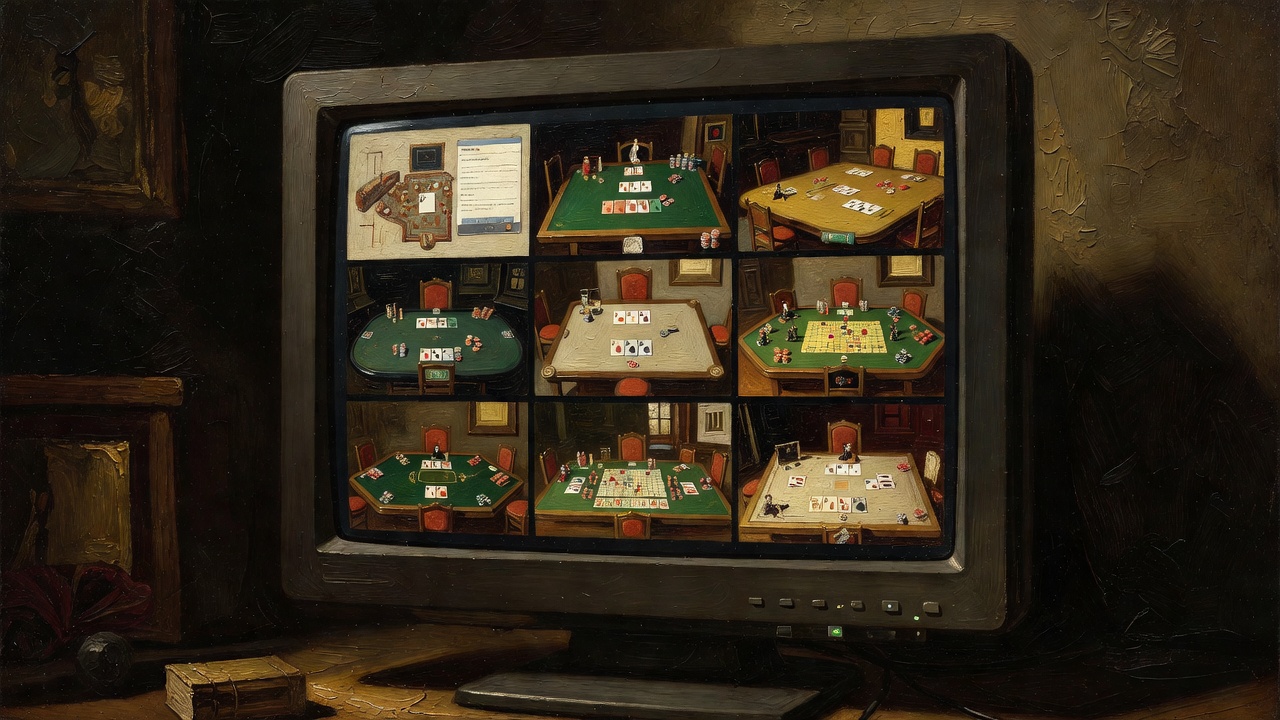
At three online tables, you have three simultaneous information streams. Each table has four or eight players. The cognitive load triples. Your attention divides among them. A good player at one table becomes an adequate player at three tables becomes a poor player at six tables. The window of decision time doesn't expand. You still have roughly five seconds to decide whether to call a raise. At six tables, you're making that decision every half second. The quality of thought decreases linearly.
The Payout Structure
A casino architect knows this: design the layout to maximize the time between decision points. Slow the game. Make the experience feel smooth. Online poker rooms do the opposite; they accelerate everything. Faster play means more hands per hour. More hands means more rake (the house cut). The room profits when you play faster, not better.
If you multi-table, you're optimizing for volume. You're saying, "I will sacrifice decision quality for decision quantity." That's fine if you're beating the game by a wide margin. A truly skilled player might beat three tables and stay profitable. But most players who multi-table are doing it because they think they can cover losses by playing more. That's the trap.
The Time Problem
A single online poker table runs about 30 hands per hour. At one table, you have roughly 30 decision points per hour where money is at risk. At three tables, you have 90 decision points per hour. At six tables, 180.
You have one brain. Your best play happens when you're rested and focused. By decision point 150, you're tired. You're not thinking about your opponent's range anymore. You're thinking about whether you can afford to order lunch.
What Works
Start with one table. Track your hourly earnings. When you have concrete data (not a feeling, but actual numbers) that you're profitable at one table, add a second. Wait two weeks. If you're still profitable and you can maintain your decision quality, add a third.
Most players plateau at two tables. A few skilled players can manage three. Almost nobody should be at six or eight unless they're grinding stakes so low that the rake doesn't matter and volume is the only lever.
The Deeper Question
If you feel the compulsion to multi-table, to fill every moment with a decision, that's worth examining. You might be good at poker. Or you might be good at distraction. The difference matters more than the hourly rate.
Pass it on
Choosing where to play? The casino ratings score each site on 6 checks, in half stars.
See the ratings