
How Live Dealer Chat Moderation Works
Chat moderation in live dealer games operates as a closed system with defined rules, escalation paths, and enforcement mechanisms. Understanding the structure reveals how casinos manage player behavior.
Jump to a section
Live dealer chat moderation is a system with distinct components. Understanding those components in isolation first, then how they interact, provides clarity.
First component: the moderation policy. Every live dealer platform has explicit rules for acceptable chat behavior. No harassment. No hate speech. No discussion of external gambling sites. No discussion of bonuses or promotions. No spoiling games for other players. These rules are written. They vary by operator.
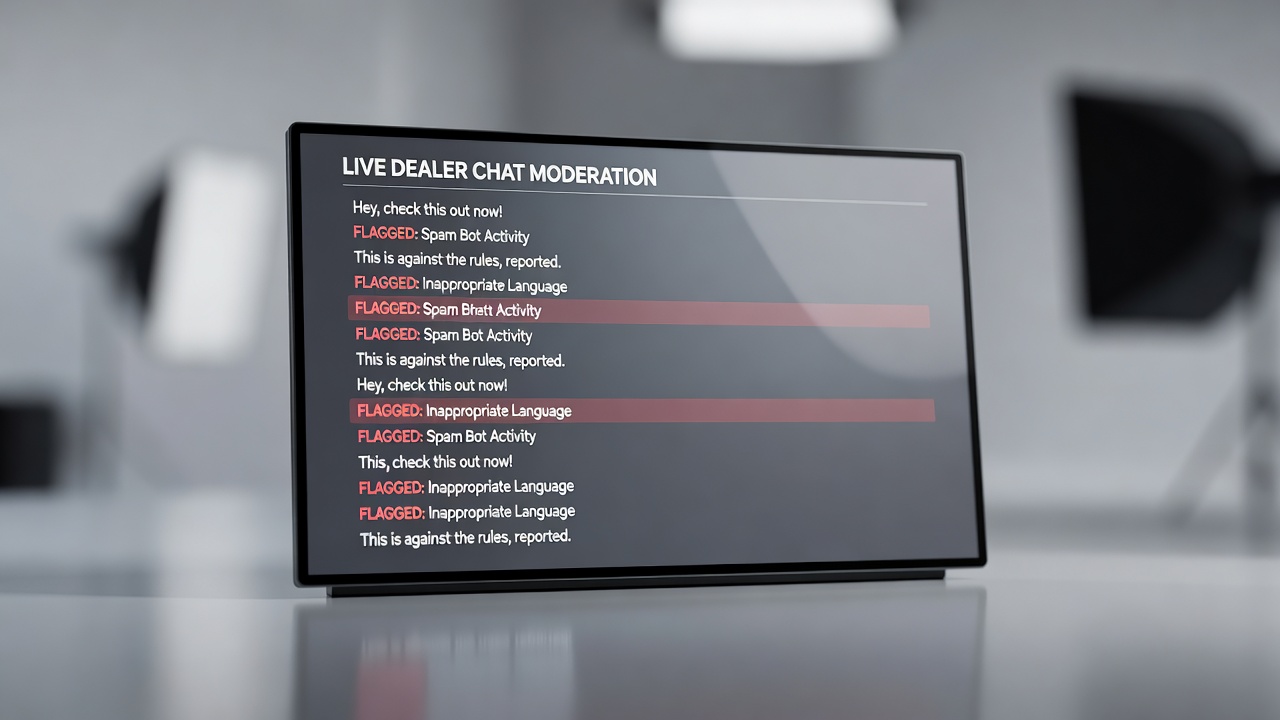
Second component: the moderation staff. A person, or several people, reading chat messages in real time. They are watching a chat stream that displays every message every player types. They read continuously during the game. When they detect a rule violation, they have tools available. They can warn the player in chat. They can mute the player temporarily. They can ban the player permanently from that table. Some operators allow escalation to permanent account bans.
Third component: the detection mechanism. Initially, moderation is human attention. A moderator watches chat. But most modern systems also use keyword filtering. The system automatically scans messages for certain words or phrases. If a message contains a flagged word, the message is either deleted automatically or flagged for human review.
The Technical Layer
Evolution Gaming, which produces the dominant live dealer software, has built keyword filtering into their system. Their database contains hundreds of prohibited terms. A message containing a prohibited term is not displayed to other players. It appears only to the player who typed it and the moderators, so the player does not know they were filtered.
This creates a specific dynamic. A player types something they think violates rules. Nothing happens in their view. They do not know if the message was deleted. This prevents testing of boundaries. Players do not know exactly where the line is.
Other systems, like Pragmatic Play, show the message to the player but remove it from public view and alert a moderator. This is more transparent: the player knows they were flagged. But it also creates confrontation potential. The player might argue with the moderator.
The most important component is context. Keyword filtering without human context creates false positives. A player might say "I want to bet against the next hand" and the word "against" could trigger a filter if the system is poorly designed. This is rare but happens. Human moderators are necessary to verify that a violation has actually occurred.
The Enforcement Layer
Temporary mutes are the first escalation. A player types something prohibited, they get muted for five minutes. They can still play. They cannot use chat. The message is gone. The game continues.
If the same player violates rules again after the mute expires, escalation is triggered. They might face a permanent mute from that table. They can play on other tables, but cannot chat on that specific game.
Permanent bans from a table are the next step. A player has violated rules repeatedly. They are removed from that table permanently. The system prevents them from joining that table in future sessions.
Account-level bans are rare but exist. A player has violated rules across multiple tables or has engaged in egregious behavior. Their entire account is terminated. The casino keeps any balance in the account as forfeiture.
The Social Dynamics
Chat in live dealer games creates social pressure that does not exist in traditional casino games. A player at a roulette table does not interact with other players in meaningful ways. A player in a live dealer game interacts with other players continuously. If one player is rude or abusive, other players are affected.
Moderators must balance enforcement with permissiveness. Too strict, and players feel monitored and leave. Too lenient, and abusive players drive away other players. Different operators strike this balance differently.
Some operators create gaming cultures where chat is highly social and friendly. Evolution Gaming's Crazy Time, for example, encourages banter and celebration. The chat is loose. The moderation is light. The culture is playful.
Other operators create business-like environments. The chat is minimal. The moderation is strict. The culture is transactional. A player is there to gamble, not to socialize. Chat is a tool, not a feature.
The Escalation Path
A complete escalation path in a typical system looks like this:
First violation: warning in chat. Moderator sends a message visible only to the offending player: "Please keep chat appropriate." No mute yet.
Second violation: five-minute mute. The player cannot type. They are notified why in a system message.
Third violation within same session: table ban. Player is removed from that table.
Fourth violation in future session: account warning. System message sent to account. Next violation results in suspension.
Fifth violation: seven-day suspension. Account is locked from all play.
Sixth violation: permanent account ban.
This path is theoretical. Actual enforcement varies. Some operators use automatic escalation. Others use moderator judgment. Some operators might skip steps based on severity of violation. Hate speech might result in immediate permanent ban. Mild profanity might result in warning only.
The Incomplete Picture
Chat moderation appears transparent but remains opaque to players. A player does not know why their message did not appear. They do not know if they were filtered or if it was a technical issue. This opacity is intentional. It prevents players from testing boundaries systematically.
The system is designed to be invisible when working correctly. Only when a violation occurs does moderation become visible. This is the opposite of traditional casino security, which is deliberately visible. A pit boss standing beside a table, surveillance cameras, chip markers: these are all visible deterrents.
Chat moderation hides its mechanisms. The player experiences removal from chat without understanding exactly why. This is effective at maintaining standards. It is also slightly dystopian in its invisibility. But in a gambling context, effectiveness typically matters more than transparency.
Subjects in this guide
Pass it on
Choosing where to play? The casino ratings score each site on 6 checks, in half stars.
See the ratings