
How to Control Tilt and Stay Focused at the Poker Table
A poker player named Marshall sat at a table in Oklahoma City. A terrible beat shattered his composure. The next hour cost him everything he had won.
Jump to a section
Marshall was a railroad mechanic turned poker professional. He had retired from maintenance work with a pension and two hundred thousand dollars. He decided to try professional poker in his fifties.
For six months, he won consistently. He understood position. He understood pot odds. He made disciplined folds. Then came the night that broke him.
Marshall held pocket queens. The board ran out nine-high with no overcards. Marshall bet the flop. An aggressive player raised. Marshall called. The turn brought a blank. Marshall checked. The aggressive player bet. Marshall called again.
The river brought an ace. Marshall checked. The aggressive player bet. Marshall called. The player showed ace-king. Marshall had the best hand until that river card. The probability of that card arriving was perhaps fifteen percent. It arrived. Marshall lost the pot.
He took a break. He did not take a break. He sat back down and played the next hand angry.
The Cascade
When you lose to chance in poker, you are not really losing to the cards. You are losing to your inability to accept randomness as a fundamental feature of the game.
Marshall understood this intellectually. Every poker player knows that variance exists. But intellectual understanding and emotional acceptance are different categories.
He re-sat. The next hand, he had ace-jack. He raised from the cutoff. The button called. The flop came king-ten-three. Marshall bet. The button raised. Marshall should have folded. He called.
The turn was a blank. Marshall checked. The button bet. Marshall raised. It was an aggressive move designed to punish what he assumed was a marginal button position raise. It was also mathematically incorrect. Marshall did not have the equity to raise.
The button went all in. Marshall folded. He lost an additional bet because of a bad decision made while emotionally dysregulated.
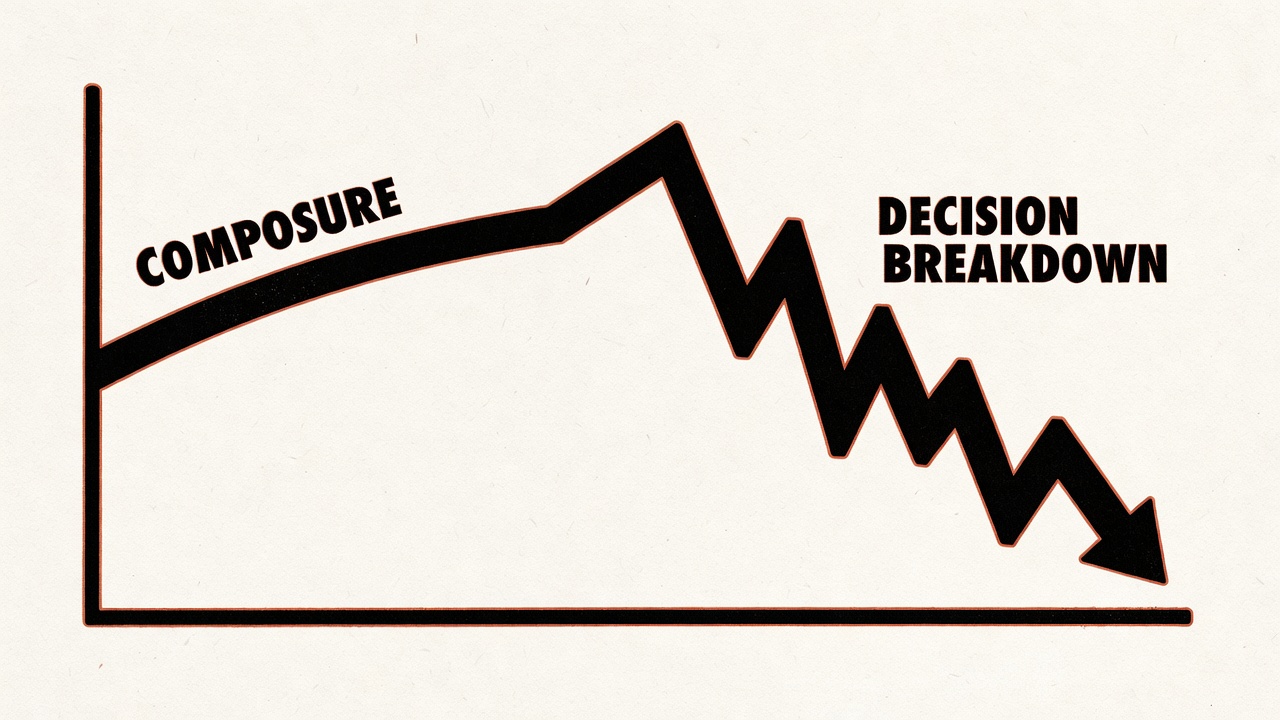
By the third terrible decision, Marshall was beyond recovery. He was not playing poker anymore. He was playing a game of recovery from losses. The game you play to recover from losses is fundamentally different from poker. It has worse odds and faster deterioration.
The Recovery Mechanism
Marshall eventually quit for the night. He had lost eight hundred dollars, which was manageable in his bankroll. But he had made three distinct bad decisions in a row, each one progressively more illogical.
A professional poker player's primary edge is not knowing better cards than opponents. It is making better decisions than opponents. Tilt eliminates this edge completely.
When tilted, a player makes identical decisions to a recreational player. The hours spent studying game theory evaporate. The discipline learned from years of play disappears.
Marshall's recovery required acknowledging that the loss was acceptable. Variance happens. Bad beats happen. A single bad beat does not represent a failure of strategy or skill. It represents randomness doing what randomness does.
The Preventive Architecture
The best defense against tilt is structural. Do not sit for ten-hour sessions. Play four-hour sessions with breaks. After four hours of play, step away for thirty minutes.
In those thirty minutes, the immediate emotional response to beats fades. You return to the table fresher. You are less likely to make compensatory bets.
The second defense is expectancy management. Before you sit, remind yourself: I will likely lose today. If I win, it is a bonus. If I lose, it is expected. This frames the session as a test of skill, not a binary outcome of winning or losing.
The third defense is pre-commitment. Decide in advance how much you will lose before quitting. Say fifty dollars. If you lose fifty, you stand. Do not re-buy. Do not chase. You step away.
Marshall never became a great poker player. He quit after eight months. But he learned something more valuable: the difference between technical skill and emotional discipline. The latter matters more in the long run. He had technique but not discipline.
Pass it on
Choosing where to play? The casino ratings score each site on 6 checks, in half stars.
See the ratings